

The Season of Advent
(information obtained from Wikipedia)
When does Advent start in 2024?
Advent always starts four Sundays before Christmas. This year, in 2024, Advent starts Sunday, December 1. When is Advent over? Advent always ends on Christmas Eve, the day before Christmas. Advent ends Sunday, December 24, 2024. When is the first Sunday of Advent? For the year 2024, the first Sunday of Advent is December 1, 2024; the second Sunday of Advent is December 8; the third Sunday of Advent is December 15; the fourth Sunday of Advent is December 22. This year, Advent ends Sunday, December 24, 2024.
The Meaning of Advent Advent is a season of the liturgical year observed in most Christian denominations as a time of expectant waiting and preparation for both the celebration of the Nativity of Christ at Christmas and the return of Christ at the Second Coming. Advent is the beginning of the liturgical year in Western Christianity.
Advent reminds Christians of the sacred meaning of Christmas. Despite the secular preparations taking place, e.g., buying presents and going to parties, Advent reminds Christians to remember and prepare for the birth of Jesus.
Advent is an important part of the Christian calendar. It means 'coming' and it's the period before Christmas, which celebrates the birth of Jesus. It is all about preparing for Christmas Day.
The Advent wreath, or Advent crown, is a Christian tradition that symbolizes the passage of the four weeks of Advent in the liturgical calendar of the Western church. It is traditionally a Lutheran practice, although it has spread to many other Christian denominations.
 If you’re of the Christian faith, lighting the Advent candles is a great way to reflect on the birth of Christ and its meaning to you. This tradition, which was historically Catholic but was adopted by Christians in the Middle Ages, spans the 4 weeks before Christmas to get you and your family thinking about the true meaning of the holiday.
The Advent Wreath is an evergreen wreath with four candles, sometimes with a fifth, white candle in the center. Beginning with the First Sunday of Advent, the lighting of a candle can be accompanied by a Bible reading, devotional time and prayers. An additional candle is lit on each subsequent Sunday until, by the last Sunday of Advent, all four candles are lit. Some Advent wreaths include a fifth, Christ candle which is lit at Christmas Eve or Christmas Day. The custom originated in family settings but has also become widespread in public worship.
Advent wreaths are circular, representing God's infinite love, and are usually made of evergreen leaves, which "represent the hope of eternal life brought by Jesus Christ". Within the Advent wreath are candles that generally represent the four weeks of the Advent season as well as "the light of God coming into the world through the birth of Jesus Christ" although each of the candles can be attributed its own significance as well. In one version of such interpretation, the candles specifically symbolize the Christian concepts of hope (week one), peace (week two), joy (week three) and love (week four).
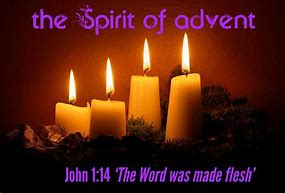 If you’re of the Christian faith, lighting the Advent candles is a great way to reflect on the birth of Christ and its meaning to you. This tradition, which was historically Catholic but was adopted by Christians in the Middle Ages, spans the 4 weeks before Christmas to get you and your family thinking about the true meaning of the holiday. You can set up an Advent wreath with candles in your very own home as a beautiful reminder of what the holiday is really about.
Advent by Mary Fairchild, Christianity Expert, General Biblical Studies, Interdenominational Christian Training Center. Mary Fairchild is a full-time Christian minister, writer, and editor of two Christian anthologies, including "Stories of Calvary." Updated on September 07, 2020
Celebrating Advent involves spending time in spiritual preparation for the coming birth of Jesus Christ at Christmas. In Western Christianity, the season of Advent begins on the fourth Sunday prior to Christmas Day, or the Sunday which falls closest to November 30, and lasts through Christmas Eve, or December 24.
What Is Advent?
Advent is a period of spiritual preparation in which many Christians make themselves ready for the coming, or birth of the Lord, Jesus Christ. Celebrating Advent typically involves a season of prayer, fasting, and repentance, followed by anticipation, hope, and joy.
Many Christians celebrate Advent not only by thanking God for Christ's first coming to Earth as a baby, but also for his presence among us today through the Holy Spirit, and in preparation and anticipation of his final coming at the end of the age.
Advent Meaning
Christmas Advent Wreath with Nativity Scene. cstar55 / Getty Images
The word advent comes from the Latin term adventus meaning "arrival" or "coming," particularly the coming of something having great importance. Advent season, then, is both a time of joy-filled, anticipatory celebration of the arrival of Jesus Christ and a preparatory period of repentance, meditation, and penance.
The Time of Advent
For denominations that celebrate the season, Advent marks the beginning of the church year.
In Western Christianity, Advent begins on the fourth Sunday before Christmas Day, or the Sunday which falls closest to November 30, and lasts through Christmas Eve, or December 24. When Christmas Eve falls on a Sunday, it is the last or fourth Sunday of Advent. Thus, the actual season of Advent can last anywhere from 22-28 days, but most commercial Advent calendars start on December 1.
For Eastern Orthodox churches that use the Julian calendar, Advent begins earlier, on November 15, and lasts 40 days rather than four weeks (in a parallel to the 40 days of Lent prior to Easter). Advent is also known as the Nativity Fast in Orthodox Christianity.
Denominations That Celebrate
Advent is primarily observed in Christian churches that follow an ecclesiastical calendar of liturgical seasons to determine feasts, memorials, fasts and holy days. These denominations include Catholic, Orthodox, Anglican / Episcopalian, Lutheran, Methodist, and Presbyterian churches.
Nowadays, however, more and more Protestant and Evangelical Christians are recognizing the spiritual significance of Advent, and have begun to revive the spirit of the season through serious reflection, joyful expectation, and through observing traditional Advent customs.
Advent Origin

According to the Catholic Encyclopedia, Advent began sometime after the 4th century as a time of fasting and preparation for Epiphany, rather than in anticipation of Christmas. Epiphany celebrates the manifestation of Christ by remembering the visit of the wise men and, in some traditions, the Baptism of Jesus. Sermons focused on the wonder of the Lord's Incarnation or becoming a man. At this time new Christians were baptized and received into the faith, and so the early church instituted a 40-day period of fasting and repentance.
Later, in the 6th century, St. Gregory the Great was the first to associate this season of Advent with the coming of Christ. Originally it was not the coming of the Christ-child that was anticipated, but the Second Coming of Christ.
By the Middle Ages, four Sundays had become the standard length of the Advent season, with fasting and repentance during that time. The church also extended the meaning of Advent to include the coming of Christ through his birth in Bethlehem, his future coming at the end of time, and his presence among us through the promised Holy Spirit.
Modern-day Advent services include symbolic customs related to all three of these "advents" of Christ.
Symbols and Customs
Elva Etienne / Getty Images
Many different variations and interpretations of Advent customs exist today, depending on the denomination and the type of service being observed. The following symbols and customs provide an overview only and do not represent an exhaustive resource for all Christian traditions.
Some Christians choose to incorporate Advent activities into their family holiday traditions, even when their church does not formally recognize a season of Advent. They do this as a way of keeping Christ at the center of their Christmas celebrations. Family worship around the Advent wreath, Jesse Tree, or Nativity can make the Christmas season all the more meaningful. Some families may choose to not put up Christmas decorations until Christmas Eve as a way of focusing on the idea that Christmas is not yet here.
Different denominations utilize certain symbolism during the season as well. For instance, in the Catholic Church, priests wear purple vestments during the season (just like they do during Lent, the other "preparatory" liturgical season), and stop saying the "Gloria" during Mass until Christmas.
Advent Wreath
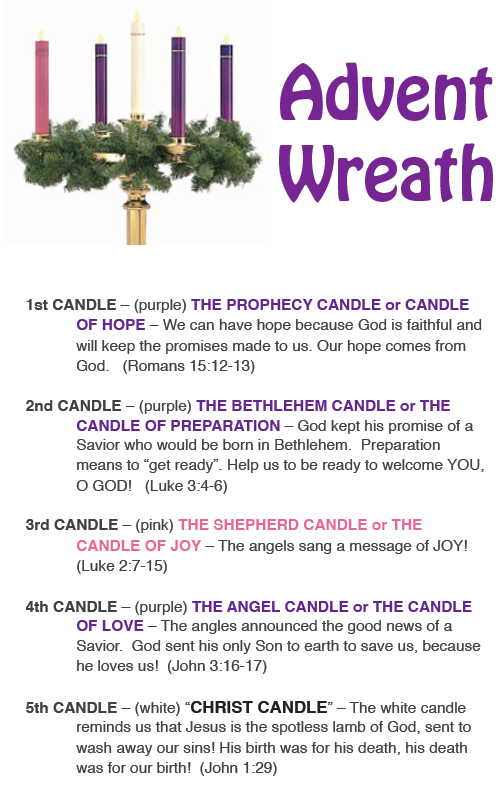
Lighting an Advent wreath is a custom that began with Lutherans and Catholics in 16th-century Germany. Typically, the Advent wreath is a circle of branches or garland with four or five candles arranged on the wreath. During the season of Advent, one candle on the wreath is lit each Sunday as a part of the corporate Advent services.
Many Christian families enjoy making their own Advent Wreath as part of celebrating the season at home as well. The traditional structure involves three purple (or dark blue) candles and one rose pink one, set in a wreath, and often with a single, larger white candle in the center. One more candle is lit each week of Advent.
Advent Colors
J-Roman / Getty Images
The advent candles and their colors are packed with rich meaning. Each represents a specific aspect of the spiritual preparations for Christmas.
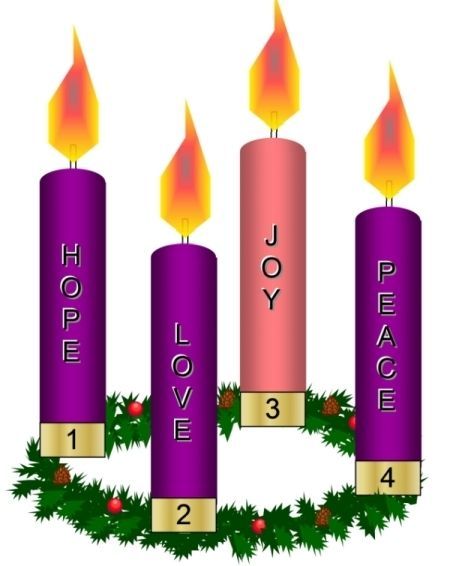
The three main colors are purple, pink, and white. Purple symbolizes repentance and royalty. (In the Catholic church, purple is also the liturgical color at this time of year.) Pink represents joy and rejoicing. And white stands for purity and light.
Each candle carries a specific name as well. The first purple candle is called the Prophecy Candle or Candle of Hope. The second purple candle is the Bethlehem Candle or the Candle of Preparation. The third (pink) candle is the Shepherd Candle or Candle of Joy. The fourth candle, a purple one, is called the Angel Candle or the Candle of Love. And the last (white) candle is the Christ Candle.
Jesse Tree
Liam Norris / Getty Images
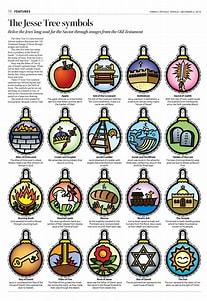
The Jesse Tree is a unique Advent tree custom that dates back to the Middle Ages and has its origin in Isaiah’s prophecy of the root of Jesse (Isaiah 11:10). The tradition can be very useful and fun for teaching children about the Bible at Christmas.
The Jesse Tree represents the family tree, or genealogy, of Jesus Christ. It can be used to tell the story of salvation, beginning with creation and continuing until the coming of the Messiah.
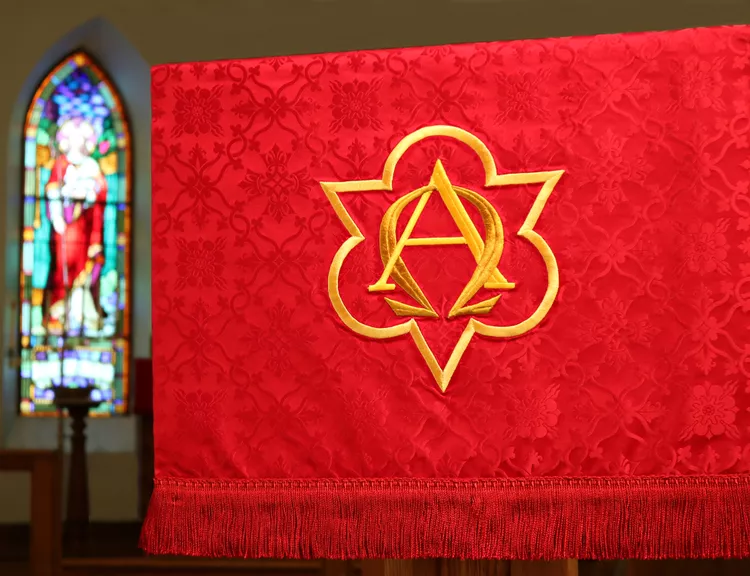
Alpha and Omega church banner in front of Jesus our Shepherd window.
Diane Kuhl / Getty Images
In some church traditions, the Greek alphabet letters Alpha and Omega are Advent symbols. This comes from Revelation 1:8: " 'I am the Alpha and the Omega,' says the Lord God, 'Who is, and who was, and who is to come, the Almighty.' " (NIV)
The Season of Advent
(information obtained from Wikipedia)
When does Advent start in 2024?
Advent always starts four Sundays before Christmas. This year, in 2024, Advent starts Sunday, December 1. When is Advent over? Advent always ends on Christmas Eve, the day before Christmas. Advent ends Sunday, December 24, 2024. When is the first Sunday of Advent? For the year 2024, the first Sunday of Advent is December 1, 2024; the second Sunday of Advent is December 8; the third Sunday of Advent is December 15; the fourth Sunday of Advent is December 22. This year, Advent ends Sunday, December 24, 2024.
The Meaning of Advent Advent is a season of the liturgical year observed in most Christian denominations as a time of expectant waiting and preparation for both the celebration of the Nativity of Christ at Christmas and the return of Christ at the Second Coming. Advent is the beginning of the liturgical year in Western Christianity.
Advent reminds Christians of the sacred meaning of Christmas. Despite the secular preparations taking place, e.g., buying presents and going to parties, Advent reminds Christians to remember and prepare for the birth of Jesus.
Advent is an important part of the Christian calendar. It means 'coming' and it's the period before Christmas, which celebrates the birth of Jesus. It is all about preparing for Christmas Day.
The Advent wreath, or Advent crown, is a Christian tradition that symbolizes the passage of the four weeks of Advent in the liturgical calendar of the Western church. It is traditionally a Lutheran practice, although it has spread to many other Christian denominations.
If you’re of the Christian faith, lighting the Advent candles is a great way to reflect on the birth of Christ and its meaning to you. This tradition, which was historically Catholic but was adopted by Christians in the Middle Ages, spans the 4 weeks before Christmas to get you and your family thinking about the true meaning of the holiday.
The Advent Wreath is an evergreen wreath with four candles, sometimes with a fifth, white candle in the center. Beginning with the First Sunday of Advent, the lighting of a candle can be accompanied by a Bible reading, devotional time and prayers. An additional candle is lit on each subsequent Sunday until, by the last Sunday of Advent, all four candles are lit. Some Advent wreaths include a fifth, Christ candle which is lit at Christmas Eve or Christmas Day. The custom originated in family settings but has also become widespread in public worship.
Advent wreaths are circular, representing God's infinite love, and are usually made of evergreen leaves, which "represent the hope of eternal life brought by Jesus Christ". Within the Advent wreath are candles that generally represent the four weeks of the Advent season as well as "the light of God coming into the world through the birth of Jesus Christ" although each of the candles can be attributed its own significance as well. In one version of such interpretation, the candles specifically symbolize the Christian concepts of hope (week one), peace (week two), joy (week three) and love (week four).
If you’re of the Christian faith, lighting the Advent candles is a great way to reflect on the birth of Christ and its meaning to you. This tradition, which was historically Catholic but was adopted by Christians in the Middle Ages, spans the 4 weeks before Christmas to get you and your family thinking about the true meaning of the holiday. You can set up an Advent wreath with candles in your very own home as a beautiful reminder of what the holiday is really about.
Advent by Mary Fairchild, Christianity Expert, General Biblical Studies, Interdenominational Christian Training Center. Mary Fairchild is a full-time Christian minister, writer, and editor of two Christian anthologies, including "Stories of Calvary." Updated on September 07, 2020
Celebrating Advent involves spending time in spiritual preparation for the coming birth of Jesus Christ at Christmas. In Western Christianity, the season of Advent begins on the fourth Sunday prior to Christmas Day, or the Sunday which falls closest to November 30, and lasts through Christmas Eve, or December 24.
What Is Advent?
Advent is a period of spiritual preparation in which many Christians make themselves ready for the coming, or birth of the Lord, Jesus Christ. Celebrating Advent typically involves a season of prayer, fasting, and repentance, followed by anticipation, hope, and joy.
Many Christians celebrate Advent not only by thanking God for Christ's first coming to Earth as a baby, but also for his presence among us today through the Holy Spirit, and in preparation and anticipation of his final coming at the end of the age.
Advent Meaning
Christmas Advent Wreath with Nativity Scene. cstar55 / Getty Images
The word advent comes from the Latin term adventus meaning "arrival" or "coming," particularly the coming of something having great importance. Advent season, then, is both a time of joy-filled, anticipatory celebration of the arrival of Jesus Christ and a preparatory period of repentance, meditation, and penance.
The Time of Advent
For denominations that celebrate the season, Advent marks the beginning of the church year.
In Western Christianity, Advent begins on the fourth Sunday before Christmas Day, or the Sunday which falls closest to November 30, and lasts through Christmas Eve, or December 24. When Christmas Eve falls on a Sunday, it is the last or fourth Sunday of Advent. Thus, the actual season of Advent can last anywhere from 22-28 days, but most commercial Advent calendars start on December 1.
For Eastern Orthodox churches that use the Julian calendar, Advent begins earlier, on November 15, and lasts 40 days rather than four weeks (in a parallel to the 40 days of Lent prior to Easter). Advent is also known as the Nativity Fast in Orthodox Christianity.
Denominations That Celebrate
Advent is primarily observed in Christian churches that follow an ecclesiastical calendar of liturgical seasons to determine feasts, memorials, fasts and holy days. These denominations include Catholic, Orthodox, Anglican / Episcopalian, Lutheran, Methodist, and Presbyterian churches.
Nowadays, however, more and more Protestant and Evangelical Christians are recognizing the spiritual significance of Advent, and have begun to revive the spirit of the season through serious reflection, joyful expectation, and through observing traditional Advent customs.
Advent Origin
According to the Catholic Encyclopedia, Advent began sometime after the 4th century as a time of fasting and preparation for Epiphany, rather than in anticipation of Christmas. Epiphany celebrates the manifestation of Christ by remembering the visit of the wise men and, in some traditions, the Baptism of Jesus. Sermons focused on the wonder of the Lord's Incarnation or becoming a man. At this time new Christians were baptized and received into the faith, and so the early church instituted a 40-day period of fasting and repentance.
Later, in the 6th century, St. Gregory the Great was the first to associate this season of Advent with the coming of Christ. Originally it was not the coming of the Christ-child that was anticipated, but the Second Coming of Christ.
By the Middle Ages, four Sundays had become the standard length of the Advent season, with fasting and repentance during that time. The church also extended the meaning of Advent to include the coming of Christ through his birth in Bethlehem, his future coming at the end of time, and his presence among us through the promised Holy Spirit.
Modern-day Advent services include symbolic customs related to all three of these "advents" of Christ.
Symbols and Customs
Elva Etienne / Getty Images
Many different variations and interpretations of Advent customs exist today, depending on the denomination and the type of service being observed. The following symbols and customs provide an overview only and do not represent an exhaustive resource for all Christian traditions.
Some Christians choose to incorporate Advent activities into their family holiday traditions, even when their church does not formally recognize a season of Advent. They do this as a way of keeping Christ at the center of their Christmas celebrations. Family worship around the Advent wreath, Jesse Tree, or Nativity can make the Christmas season all the more meaningful. Some families may choose to not put up Christmas decorations until Christmas Eve as a way of focusing on the idea that Christmas is not yet here.
Different denominations utilize certain symbolism during the season as well. For instance, in the Catholic Church, priests wear purple vestments during the season (just like they do during Lent, the other "preparatory" liturgical season), and stop saying the "Gloria" during Mass until Christmas.
Advent Wreath
Lighting an Advent wreath is a custom that began with Lutherans and Catholics in 16th-century Germany. Typically, the Advent wreath is a circle of branches or garland with four or five candles arranged on the wreath. During the season of Advent, one candle on the wreath is lit each Sunday as a part of the corporate Advent services.
Many Christian families enjoy making their own Advent Wreath as part of celebrating the season at home as well. The traditional structure involves three purple (or dark blue) candles and one rose pink one, set in a wreath, and often with a single, larger white candle in the center. One more candle is lit each week of Advent.
Advent Colors
J-Roman / Getty Images
The advent candles and their colors are packed with rich meaning. Each represents a specific aspect of the spiritual preparations for Christmas.
The three main colors are purple, pink, and white. Purple symbolizes repentance and royalty. (In the Catholic church, purple is also the liturgical color at this time of year.) Pink represents joy and rejoicing. And white stands for purity and light.
Each candle carries a specific name as well. The first purple candle is called the Prophecy Candle or Candle of Hope. The second purple candle is the Bethlehem Candle or the Candle of Preparation. The third (pink) candle is the Shepherd Candle or Candle of Joy. The fourth candle, a purple one, is called the Angel Candle or the Candle of Love. And the last (white) candle is the Christ Candle.
Jesse Tree
Liam Norris / Getty Images
The Jesse Tree is a unique Advent tree custom that dates back to the Middle Ages and has its origin in Isaiah’s prophecy of the root of Jesse (Isaiah 11:10). The tradition can be very useful and fun for teaching children about the Bible at Christmas.
The Jesse Tree represents the family tree, or genealogy, of Jesus Christ. It can be used to tell the story of salvation, beginning with creation and continuing until the coming of the Messiah.
Alpha and Omega church banner in front of Jesus our Shepherd window.
Diane Kuhl / Getty Images
In some church traditions, the Greek alphabet letters Alpha and Omega are Advent symbols. This comes from Revelation 1:8: " 'I am the Alpha and the Omega,' says the Lord God, 'Who is, and who was, and who is to come, the Almighty.' " (NIV)